Showing posts with label "High-tech Tank". Show all posts

Sunday, November 1, 2015

Plants of the Month: September 2015

Every month I will be rating the quality of the plants in all my tanks and who is the most valuable plant (MVP) for the month. The criteria are the following:

1. Are the stems leggy?
2. Are the leaves broad and compact?
3. Is it an algae magnet?
4. are the old/bottom leaves holding up or melting?
5. is the color vibrant? red plants red? purple plants purple? green plants green?
6. any presence of leaf holes or melting anywhere?
7. too much root growth along the stems?
8. is it very invasive in growth pattern?
9. are leaves curling? bottom, new, or all?
10.  when trimmed, how many new stalks grow out? or is there no new growth?
11. does it perl during photosynthesis?
12. does it grow thick and lush?

Ratings will be based on plants performance for the month. For this month, here are the list starting with the best plant.


1. Alternanthera Reinickii Mini
I finally figured out how to make plants such as this to turn red. A combination of iron, traces, and correct light wavelength certain does the job. I never seen this so red before, let alone in my tank! With its color standing out, it earn the right to be the top plant of the month!


2. Ammannia Sp. Bonsai (Rotala Indica)
This to me should have been the winning plant of the month if its tips had turned brown or red. Unfortunately it's a little too green at the moment. Regardless, it has grown compact, thick, vibrant, and organized. This is a plant that must be in any aquascape out there.


3. Limnophila Hippuroides
It does not grow fast compared to other stem plants. But it does not grow slow either. It is a huge plant but not too big for my tank. It will however need to occupy the whole left mound of the tank but that's fine. It's beauty gives it permission to do so. I also like that the older, bottom leaves are not rotting due to lack of light exposure. I've seen this plant look really bad in LFS's where older leaves just melt. The top leaves are growing more compact and purple even. I expect this plant to be the best in the tank someday.


4. Hydrocotyle Tripartita Japan
Many times did I fail in growing  this plant. It grows, but look very unhealthy. Leaves curl, too much root growth along the stems, and gets covered by GDA and look like a mess. It's a totally different story this time. It just explodes in growth and very invasive. There are barely any curling leaves and no roots growing along the stems. I think this plant loves a lot of calcium and probably phosphate. The high amount of fertilizer dosing likely help get this plant grow really well this time.


5. Micranthemum Monte Carlo
It has grown to at least an inch thick in just a month. That's a good growth. In my previous tanks, it took me a much longer than that to be able to carpet the whole lawn. This time, it happened probably in just two weeks so this is a progression in terms on growing this plant. I will try to see how thick I can grow this until it starts to kill off bottom leaves.


6. Eleocharis Sp. Mini
It was not in my list of plants to use when I was still shopping for plants. I only noticed and realized that I can probably try this when I saw one. I thought at that time I will buy glosso. Fortunately I changed my mind then and bought this instead. good decision. I now know that this is an easy carpet plant to care for. it also grows thick, lush, and naturally messy. I plan to move this in the new living room tank as its primary carpet plant


7. Pogostemon Helferi Downoi
This plant is the slowest grower in the tank. It grows upwards though so it might not be getting enough CO2. Or maybe the tank is too deep for it? I will try to plant some of these in the new, shallow tank and observe the difference. In any case, I am happy that I'm able to grow these plants without issue. I was concerned from the beginning when I got this plant as it has this reputation of being a difficult plant to grow.


8. Hygrophila Araguaia
I don't have issues with its growth rate or quality. it also crawls nicely and there were no melting leaves at all. Leaves turn dark brown (in a good way) when exposed to red spectrum lights (giesemann super flora). What I don't like is its size and messy growing habit. it is just everywhere and clumping together and sticking as close as it can to the soil. to me, it's an eye sore. Perhaps there's a nice layout that this plant fits in but it's certainly not this tank. So the plan is to move this out and try planting in the other (new) tank soon.


9. Ludwigia Sp. Guinea
This is a beautiful plant. I didn't know this plant before until I found it in when I was shopping for tissue cultured plants. It's a good decision to pick this up. It is not a demanding plant and can grow really good red and green mix in the leaves. It grow very leggy using EVO LED light which was mixed with the T5HO's. Now that I am using T5HO's exclusively, it grows more compact and wider leaves.


10. Rotala Macrandra
It has the reputation as one of the hardest plant to grow but that's not the issue I have with it. In fact I find its growth rate a little too fast. The problem was the quality of growth. It grew "stemmy" and distance between leaf nodes is very high. Leaves are thin and long, a direct contrast to the thick, wide, and short leaves I see on the internet. Color is pale yellow and just a hint of red. I'm suspecting it was due to exposure from Green Element EVO LED light. I was using it along with the T5 light during the first two weeks. It seems that It has very strong PAR and forces the plant to grow too fast while not being able to provide enough CO2. since I removed the LED and increase the distance of T5 from plants to reduce intensity and increase spread, the plant grow more compact and wider and shorter leaves. The color is still yellow though so that's another issue I have to address in the future.


11. Ludwigia Inclinata Curly
There were no issues with growing this plant, but it does not look very attractive to me. I guess this plant is suited for much larger tanks. It has thin, long, and twisted leaves and I'm not sure how to grow them to be more compact. As easy it is to grow them, I will have to remove them to give space to other plants more suited in the tank.


12. Proserpinaca Palustris
I have very high expectation with this plant. It was to me the most beautiful plant among the 12 species in the tank. It grew fast, but the quality is way below what I expected. It suffered with the same "stemmy" issue as rotala macrandra. It is also very green. I only start to see new growth turning orange when I switched the light to Giesemann (super flora and tropic). After trimming, new growth is still slightly green but more compact now. I guess that EVO LED is not really meant to turn plants red... or maybe I'm not using it right.


Saturday, August 15, 2015

Day 1 "Lullaby": It's up and Running!

The bedroom tank is now operational!


Here's the list of plants
Micranthemum 'Monte Carlo'
Hygrophila 'Araguaia'
Pogostemon Helferi 'Downoi'
Proserpinaca Palustris
Alternanthera Reinickii 'Mini'
Ludwigia Inclinata 'Curly'
Ammannia Sp. Bonsai
Limnophila Hippuroides
Rotala Macrandra
Hydrocotyle Tripartita 'Japan'
Eleocharis Sp. 'Mini'
Ludwigia Sp. Guinea


CO2 injection is via in-line reactor connected to EHEIM 2215 outlet pipe. It is upgraded to an EHEIM 2217 impeller so it's a little stronger than typical 2215.


Light Source To Be Replaced

Light is a combination of Green Element EVO LED 3Wx16 7500K-10000K and Odyssea 4x24W T5HO with 6500K and 7500K bulbs. These light sources are temporary only.
I will change it later to a 6 bulb T5HO that is combination of 15000K, 10000K, and 6500K bulbs. I'm looking into Geisemann T5HO's. They have great bulbs for planted tanks with awesome spectrum. I might also use ATI for the purple (15000K) one. Geisemann though has something similar as well and their spectrum look the same. Of course I will lift it up higher than usual as 6 bulbs is obviously too powerful. I just want the spread so 6 bulbs is a good thing.


Adding a second filter and address the issue on gas exchange
I also plan to install another canister filter. I have an EHEIM 2213 which should be fine but it's used in the discus tank right now. I'm thinking of installing an in-line diffuser and inject O2 via aerator which will run during the night. Then my spare lily pipe will be used to add surface agitation. As of the moment, gas exchange is bad. There's literally no surface agitation and this must be addressed soon.


Friday, August 7, 2015

"Lullaby" Tank Preview


This is our new bedroom tank! 


Here's the detail of the new tank called "Lullaby":

Tank:
ANS OPTICLEAR CUBE 60W
60x45x45 cm, 8mm Thick
Crystal Glass, Low-Iron

Layout:
Iwagumi
Koke Stones

Water Conditioning:
EHEIM 2215 Canister Filter
Ocean Free Surf Clear Surface Skimmer

CO2:
Leilih 3L CO2 Aluminum Cylinder
Up-Aqua Dual Gauge Solenoid Regulator
ISTA Mix Max CO2 Reactor

Light:
Odyssea Green Element EVO LED 3Wx16 7500K/10000K
Odyssea QUAD 4x24W T5HO 6500K/7500K


More Pictures:


Monday, August 3, 2015

Day 168 "Metaphor": Blyxa Japonica Removed, Ludwigia Red Added, Monte Carlo Recovering Nicely


Phosphates 
I continue to dose high amounts of KH2PO4 but test kit shows I'm still shows 0.5 mg/L at best. There's been consistent improvement with plants so that's good. Maybe I should consider reducing it next week, probably around 10-15 mg/L.


Trace and Iron Dosing
I measured Fe before dosing anything in one afternoon and I got 0 mg/L. Then I dosed 4 drops of Rexolin APN liquid which is approximately 0.2mg/L of its powder form. With that dosage, I should get at least 0.1 mg/L if my bottle concentration is 100g/120mL. I measured and indeed found 0.1 mg/L! It might be true after all that the concentration of this bottle is as accurate as it says.
However, when I dosed 0.4 mg/L, I'm able to measure only 0.1 mg/L in the tank. Is the soil absorbing excess Fe to limit it to 0.1 mg/L just like phosphates being limited to 0.5 mg/L?


Monte Carlo
Monte Carlo carpet has gone through major trimming last week. I left the back lawn untouched. It is growing well without a problem. After a week it grew nicely. It's still a few more weeks to go before the lawn gets thick and lush but it's on its way there. No more new growth in bad shape.
There's very few older leaves that melted but it's not so bad, still will keep a look at them. Some very old leaves are not as healthy. Their color is dark green. Are they just really healthy? Were they covered by top leaves and are deprived of light? Are they covered by GSA? Not sure... Any ways, here are some pictures.


Middle front starting to grow nicely


Right front corner growing nicely as well


Back lawn spreading

Ammannia Bonsai
Not sure what happened in this plant. There were 4 original stalks planted. About a week or more It has established itself and growth is slow but good. Then I trimmed and replant. Now, all trimmings are gone, and the original 4 are dying... it's in the corner of the tank with poor circulation and CO2 so there's that.
What's interesting is I planted one stalk from the original pack in the Discus (Low-tech) tank. It's growing fine but very slow. I rather not touch it though.

Ammannia Bonsai melted for some reason so I put some MC trimmings in their spot instead
Blyxa Japonica Removed
As planned, I removed this plant in order to give room for Staurogyne Repens and AR mini. Those two are the plants that I'm not able to grow consistently nice. This time, I'm placing them in the best spot to grow.


Ludwigia Red Added
These are trimmings from my an old plant in the  Discus (Low-tech) tank. It's in bad shape and I'm hoping it recovers here and grow well.


And finally, the tank's latest shot...


Monday, July 27, 2015

Day 161 "Metaphor": Good Days Ahead

Increasing Trace, Now Using Rexolin APN

Half way through last week I continue to see poor health on new leaves in Monte Carlo, despite the increase in Fe dosage and dosing frequency. So I decided to start increasing trace dosage as well.
Using Rexolin APN, I start dosing at around 0.2 to 0.4 grams per day until the end of the week. It seems a lot but I just want to saturate to make sure we are not limiting this nutrient. I didn't notice any negative effect though.
In fact, I start to see improvement in Monte Carlo. New growth are now in good shape. The new leaves are much more green now and the leaves are bigger than usual. This is a good thing.
I will continue to dose more trace next week. I will also keep Iron at the same dosage as last week to ensure we are not limiting this nutrient as well.
Even Blyxa Japonica is a lot more green now. It's new leaves look thicker than before and they pearled a lot like I never seen before so obviously we're doing something right here.

Monte Carlo Growh at Middle Back Area of the Tank


Another Shot of Monte Carlo at the Back Area


Monte Carlo Front Lawn is Trimmed to Allow New and Healthy Growth

Increased Phosphates Dosing Continued...

The aquasoil kept buffering it down to 0.5 ppm so that's good. It means I can just keep "overdosing". I don't see any negative effect on plants nor algae bloom trigger.


Dosing Summary From Last Week

Below are the dosing total (in mg/L) from last week. That's a ton of phosphates and Iron right?  It's fine. there were no algae's at all. not a single BBA. Not a stain of green on the glass walls.
Nitrate is naturally high on the tank so don't need to dose any. I will continue to monitor it however because if nitrate bottoms out it will affect plant growth significantly

.NO3 6.140
.PO4 22.373
.K 46.979
.Fe 3.635
.Ca 4.982
.Mg 1.500
.Cu 0.026
.Mn 0.275
.B 0.109
.Zn 0.133
.dGH 1.032
.Co 0.004
.Mo 0.025
.Na 0.020
.Cl 0.177
.S 9.951


Replanting Staurogyne Repens

Since increasing phosphate and iron dosing I see improvement in these plants. New leaves look healthy and green. It used to be that "burns" appear all of a sudden on middle leaves but I don't see any melting ones like that anymore.
However, older leaves that were already suffering from GSA long before increasing phosphates and iron continue to be covered by GSA. This make the plants look unsightly and gives a false impression that they are still suffering from nutrient deficiency. They are also likely to remain this way and die off eventually. 
So the best option is to pull out the plants, remove all infected leaves and replant them. But the long term plan is to remove Blyxa Japonica in the tank and move Staurogyne Repens to their spot.
I intended to do all these this weekend during maintenance but decided to hold off this plan for now.

Staurogyne Repens Getting Better But Older Leaves are Still in Poor State


New Filter Outlet Pipe

This is not just for aesthetics. I find this design is the best outlet lily pipe for canister filters with in-line CO2 Reactor. It has minimum resistance to flow and the opening mouth does not twirl the water coming out so much. It also points downward so CO2 gets dispersed far and low reaching the carpet plants conveniently. 

Tuesday, July 21, 2015

Day 154 "Metaphor": Pearl Weed Replanted and New Plant Added

Pearlweed Replanted (Not By Choice)

Accident. I pulled a few stalks off the soil at the back during maintenance. No way to push their root down the soil because that spot is surrounded by rocks that are almost sticking to the glass wall so I leave them be. Since the plants are still attached to neighboring plants it didn't float. However, they melt in time and eventually lifted up. When I tried to pull them out for replanting, the rest of the plants got pulled as well. They are all connected through main stem and roots at the bottom.


So here's the side of the tank with newly planted pearl weed.


Ammania Bonsai, New Plant

Added this a couple of weeks ago. The picture is not the best out there but then again It isn't really in best shape yet so let's just wait until they grow before we take a more professional shot on them.


Installed Seachem Purigen in Canister Filter

After replacing the impeller, I also put in Seachem Purigen (in a bag) inside the canister. I heard so much good things about this product but have yet to use one so this is a chance. So far it does not affecte the nitrate levels in the tank. After water change, nitrate was at 0 ppm but it went up to its normal level of 20-40 ppm the next day. I don't really see any difference in water clarity but then again prior to using this, the clarity has been absolutely pristine often times specially after water change. I hope it improves on controlling the amount of organic matter in the tank though, stuff that you won't normally see.


Pumping Iron This Week

Plants' response on increased phosphate dosing is positive. Growth rate has increased in monte carlo and all the plants just look a lot green than before. What I noticed now is that several new leaves of monte carlo are transparent and melting so it could be suffering from iron deficiency this time. It might also be trace issue but let's figure this out one nutrient at a time. This week, I will be dosing Seachem Flourish iron at more than twice the amount I was dosing and will do it everyday as well. Target is around 5 ppm total for the week.


Sunday, July 19, 2015

Day 152 "Metaphor": Addressing Nutrient Deficiencies


Dealing with Phosphate Deficiency


Staurogyne Repens with unhealthy leaves at middle node
Over the last couple of weeks I increased my phosphate dosing to 20+ppm. I significant jump compared to my previous dosing amount of 4-5 ppm. This is in  response to the long ignored issues such as GSA and instantly melting leaves in staurogyne repens, melting and slow growth on monte carlo, and iron deficiency like symptoms on AR mini.


Visible GSA covering most of the old leaves
I am dosing KH2PO4 on daily basis to ensure there's enough on water column all the time. I have to dose 4+ppm everyday just to keep up with the 0.25-0.5ppm amount on water column. At first it's strange that the plants seem to absorb too much but then I realized ADA aquasoil is likely to be absorbing most of them. That's fine because I read somewhere before that phosphates are best absorbed by plants through roots (I need to confirm this later).

Perhaps in time when there's enough phosphates in the soil, it's not going to absorb too much any more so I can dial it down a bit. I just need to keep taking measurements on a weekly basis to monitor the tank's uptake.

I will keep up with this because I start to see huge improvement on monte carlo. It's a lot greener now and the stems look firm. Growth's been fantastic too!


As for Staurogyne repens, I see improvement but GSA is still on older leaves. Some leaves in the middle of the stalks are still suffering from holes and instant melting but it's not a lot, at least compared to when I was dosing much less phosphates. This might be due to other deficiency which I am also addressing at the moment.


Iron Deficiency in Alternanthera Reineckii Mini

I am using Seachem Flourish Iron as Iron fertilizer and dosing it 3 times a week at minimum suggested level via EI method. Bad idea. Flourish Iron is based on gluconate as chelating agent and iron gets consumed or precipitate in just a matter of minutes after it's dosed in the water column. It is suggested that when using Flourish Iron, it's best to dose it daily to ensure its available for plants most of the time.
Alternanthera Reineckii Mini New Leaves Melting

I've been dosing a total of 1.5 ppm Iron per week using Seachem Flourish Iron liquid fertilizer. I stagger it every other day. This week I triple the dose and dose it everyday instead. Flourish Iron uses gluconate as chelating agent and it does make iron get consumed quickly by plants or precipitate in a matter of minutes. Not dosing it frequently may leave plants without Iron supply for a period of time.

In any case, I managed to get EDTA and DTPA Iron powders and will use these in future. Those chelators will keep iron longer in the tank and I will probably be able to measure its uptake.

As for the plants, staurogyne repens improved after increasing phosphate dosing but certain problems remain. as I mentioned before, older leaves still suffer from GSA and some leaves in the middle stems still suffer from holes. It will probably get better in time and it may not be iron deficiency at all but it probably won't hurt to increase iron dosing.

AR mini shows the most obvious iron deficiency symptoms. Just a few days ago, It's middle and older leaves improved and it appears more red. But new leaves are melting like crazy. This is after increased phosphate dosing for a few weeks.

Although monte carlo has improved significantly, I still notice a few new stems and leaves melting and this maybe due to iron deficiency as well. However, this may also be due to magnesium deficiency.


General Hardness: Magnesium and Calcium are "Secondary Macros"


Monte Carlo with a few new leaves melting 
Although water hardness is at 5 dGH, there may not be enough magnesium. I have no way to measure this so I'm going with a guess if either magnesium or calcium is lacking in the water. In any case, I haven't been dosing Seachem Equilibrium in the tank for several months. This would have probably addressed this issue so last week I dropped at least 8g of Equilibrium and my GH jumped to 8. Is there improvement with the plants? Yes, but I can't tell its because of magnesium and calcium from Equilibrium that caused it. Note that I am also dosing increased amount of phosphates and iron at this stage.

Potassium
Do I need to worry about this? Since I started increasing phosphate dosage I also increased K. I'm dosing at 40 to 50+ppm per week now. Unfortunately I have no test kit to measure the tank's uptake but I think it's something I should worry about. Experts claim it's fine to have a lot of K floating around the tank and with a weekly water change, you always keep it under control.

In any case, we still see some leaves at the middle of the stems in staurogyne repens melting and having holes so it's best to have enough potassium floating around the tank all the time.

Nitrates
Now this is the one I have abundance in the tank. I always have 40+ ppm floating around that last week I dosed only a total of 2 ppm. This week I won't even bother to dose any but I need to keep measuring to ensure there's enough in the tank for plants to take.

Algae? What algae?
With all the fuzz about over abundance of fertilizers in tank will cause algae bloom, I think it's all hogwash. After increasing dosage levels on all nutrients, there's been no sign of algae of any kind in the my tank. In fact, water's quality has never been this better. I might be saying things too soon so we'll in a few more weeks...


Thursday, July 9, 2015

Day 142 "Metaphor": It's Been A Long Time!

Well it's been a while since my last update. But hey it's better late than never! Anyway, from now on I will be posting updates more frequently. So here are the latest images of the tank. A lot has changed...


AR Mini replaced by pearlweed
Pearlweed grows fast but i don't mind. I find them one of the best plants for "scaping" due to their ability to grow thick, compact, and lush in a very short time. It's also nice that the lower part of the plant does not melt in time - either due to high light or pearlweed just don't need much light source. Other stems plants like rotala rotundifulia and Luwigia sp. red has their bottom part melting in time, at least from my experience.

Blyxa Japonica is getting a lot of attention
Every time I posted images of this tank in a social network or planted tank community, the first question i'm ask is "What is that plant to the right?". If I'm one of those that saw the pictures, I will probably ask the same question. I didn't intend for this plant to look this way, but it did. Blyxa Japonica is a plant I don't see often used by professionals. But I think it has a lot of potential for creativity.

Do I need to dose more potassium?
I have been dosing less than 20ppm of potassium in this tank since the beginning. Plants such as hydrocotyle tripartita and staurogyne repens were struggling to grow from the start. I had to remove almost all of the hydrocotyle tripartita because it looked really bad. Then last week I started to dose more than twice as much potassium as I do, and immediately I noticed staurogyne repens looking really green and lush. I'm starting to suspect that I've been depriving these plants of potassium all along. I will continue to dose potassium at more than 40 ppm a week and see if these plants will rebound.
Pearlweed and blyxa were fine though. I guess they are more into nitrates than potassium and this tank never had nitrate deficiency so that probably explains that.

One dwarf puffer for all the snails in the world.
At one point the tank is infested by limpet and ramshorn snails. they populate very fast. adding one fresh water dwarf puffer fish solved this problem. I never seen the fish hunt or eat one but since it has been introduced, the population has dwindled drastically. At this point, I cannot see any of them any more. It used to be that they crawl all over the glass and scatter their eggs everywhere. Unfortunately one day I saw the puffer fish on the floor. I didn't know it can jump as well. It was probably spooked. I'm pretty sure there's still a small population of these snails hiding in the soil and will soon wreak havok again sometime, but i'll be sure to get another dwarf puffer when that happens.

BBA vs. Excel: Excel Wins!
BBA got a little bit out of control at one point but thanks to Seachem Flourish Excel, they are gone now. Every week, before I do water change, I spot dose any BBA i see in the tank. Then I leave it for 15 minutes before I start draining the water. It worked, their reproduction rate decreased greatly. Now I only see 1 or 2 small clumps sticking in the rocks every time I do water change. In time, I don't expect to see any.
I also installed a small pump to improve water flow in the tank. That might have helped reduce presence of BBA as well because I notice they either grow in a dead spot or in an extremely high current area in the tank like outlet pipe opening.

Monte Carlo is still in progress
It has finally exploded in growth over the last few weeks. It filled the front lawn and required me to trim so as not to let the bottom area to melt. The back lawn and the sides still need some growth though before it can fully fill the whole tank. I hope it happens soon. It's been a long time!

So in summary, things are getting better. It still has a long way to go before it reaches the goal I have in mind for it but it's in the right direction. I'm considering to add a new plant to make the right side more natural and put a little balance on that side. I'm thinking of ammania sp. bonsai. From here on, I will try to be post updates more frequently.


Monday, March 30, 2015

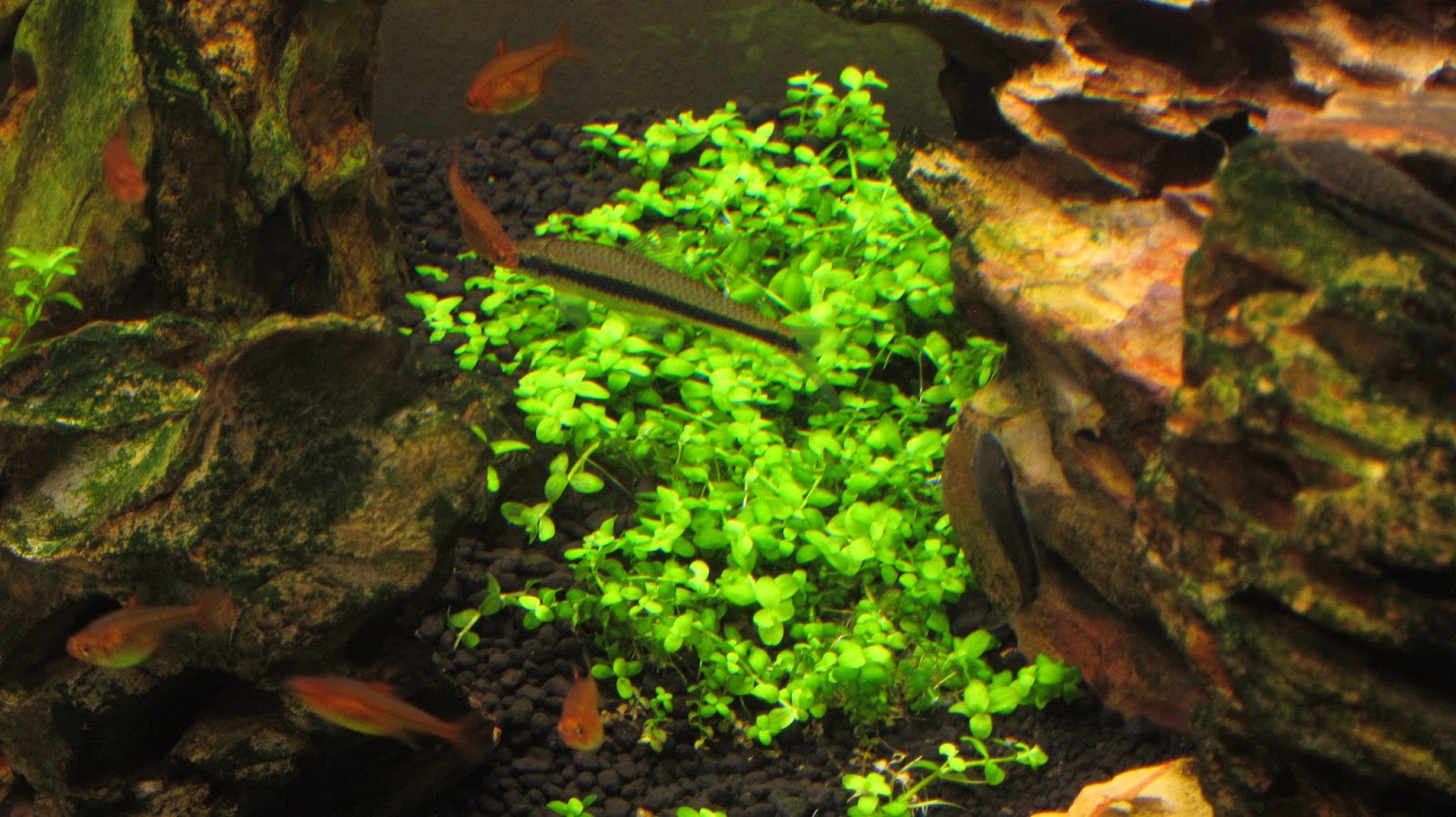
Day 54, "Metaphor": Siamese Algae Eaters Take Down Green Algae

It's been a while since my last update. A lot has changed since. After the diatom stage, green algae started to infest the tank so I introduced Siamese Algae Eaters to combat them.


Here's a summary of changes that occurred since the last update.
  • Siamese algae eaters introduced
  • Minor rearrangement on equipment
  • New light fixture
  • Added more Amano Shrimps
  • Introduced Siamese Algae Eaters 
  • Brazilian Pennywort is replaced by Pearl Weed
  • Althernanthera reinikki mini needed major trim

Siamese Algae Eaters Loves Green Algae
Once the diatoms die down, green algae started taking over the tank. I ignored it for a while as they slowly cover the rock surfaces. Then they started getting very thick and hairy along the rocks and glass walls become unsightly as they started covering them too, so I added 3 new SAE's and they clean them all up in a day.


Inlet/Outlet pipes relocated to improve water flow
I rearranged the equipment in the tank to optimize space. If you compare the picture below from my previous posts, you will notice the differences.

So the following were the changes:
  • Filter inlet/outlet pipes were move to the back. I was able to do this now because I replaced the inlet strainer with a smaller one. This allow me to push the pipes back without hitting the rocks and soil mound.
  • Surface skimmer is moved to the other side. The small current it produce help the flow around the tank.
  • CO2 drop checker is moved into the spot where inlet/outlet pipes were previously located

Odyssea QUAD 60-80cm 4x24W T5HO with LED "moon light" 
I replaced the light set with a new fixture. It features 4x24W 6500K T5HO bulbs with blue LED's for "moon light" option. Every pair of bulb has its own ballast and power plug so I can control each pair's lighting schedule, The LED moon light option is also powered by a separate DC adapter so can also have its own lighting schedule.

This is the lighting (and CO2) schedule now:
1st Pair: 1PM to 10PM
2nd Pair: 3PM to 11PM
LED: 10PM to 7AM
CO2: 11AM to 9PM

The light starts and ends at lower intensity but peaks in the middle of the day until evening. Moonlight then starts at night until the next morning.

I also replaced 2 of the bulbs with 7500K 24W to provide a wider range of spectrum. The performance is great. Light intensity is very obvious and I can see the althernanthera reinikki mini with stronger red coloration.
The plants reacted positively with the new light as well. Over the last couple of days since I installed it, they "pearl" like I never seen before. It's like there's a stream of air stone injecting gas all over the tank. Below is the video of pearling in action.
From here on, I will be dosing fertilizers at maximum rate in order to keep up with light and CO2 supply.


More Amano Shrimps.
To strengthen the numbers of my clean up crew, I added 9 new Yamato shrimps, also known as Amano shrimp. They are great scavengers and very good competition against otocinclus with regards to eating algae. They are also hardy. The downside is that they may occasionally jump out of the tank if they are not happy or threatened and that happened to me before!


Hemianthus micranthemoides (Pearl Weed) replaced Brazilian Pennywort
As much as i love brazilian pennywort, it has to go. The leaves are just too big to fit into the aquascape. Too bad they are perfect place for shrimps to hang out. It is replaced by pearl weed, which has very small leaves and compliments well with monte carlo.


4 weeks in and Althernanthera reinikki mini met my expectation.
It is very beautiful. None of them that I planted actually died, The leaves are big, smooth, and wide. The stems are stiff and roots are not messed up. It is a strong contrast in my experience with AR roseafolia. Unfortunately, with the build up of green algae, it covered some of this plants leaves. So I decided it's the perfect time to trim them. After a few weeks, I expect the growth to be more compact and smaller leaves.


Casualties...
Borneo sucker didn't last long. It died a couple of days after It was introduced in the tank. It is known to be very sensitive and prefer a river stream type of water, meaning high current. My tank has very gentle water movement so it's not the best environment for it. I guess I won't ever get this fish again. Too bad they are really gorgeous.
A total of 4 ember tetras died as well since a few days after they were introduced. I'll take it as that they just didn't acclimate well in the tank. Water parameters are fine and the rest are swimming and eating fine. In any case, I will continue to monitor water condition to ensure they are in a habitat ideal for them.
Two of the amano shrimps also died just a few days after they were introduced. These shrimps are typically caught in the wild and due to the amount of stress they go through upon reaching our tanks, it's not surprising that some of them die. In general, they are hardy shrimps and can live for a very long time once they acclimate in the tank.